
First Edition · The book for sales leaders
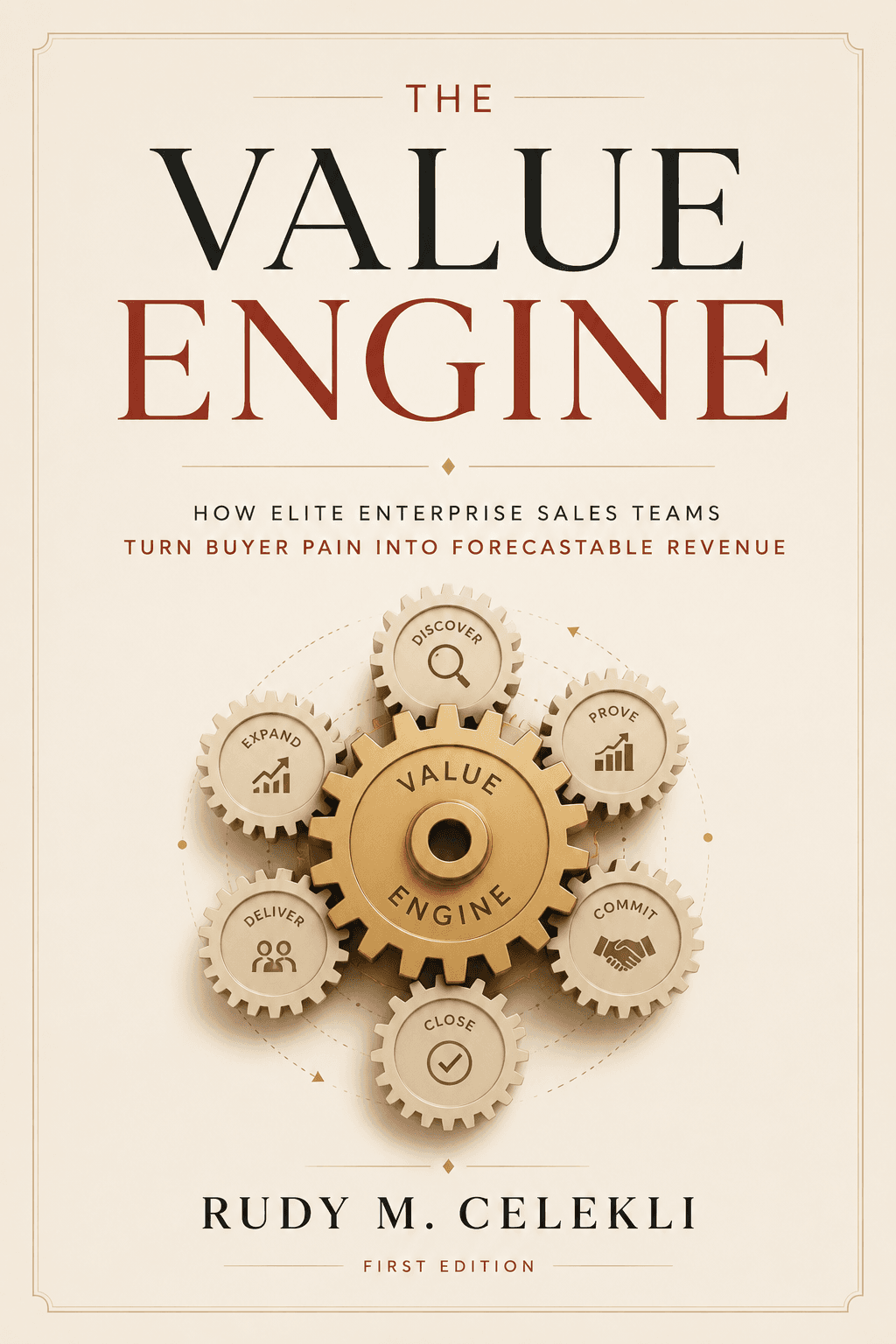
The Value Engine
How Elite Enterprise Sales Teams Turn Buyer Pain into Forecastable Revenue
Rudy M. Celekli
“Quiet is how deals die. They almost never die loudly.”
The Value Engine · Chapter One
Seven-figure deals don’t die because the product failed. They die when a CFO asks why this has to happen now — and the room goes quiet. This book exists so that everyone on your team always has that sentence: the customer’s cost of delay, in one line, with a number in it.
Don’t take our word for it. Open the book.
Drag a corner · or use the arrows
The Value Engine
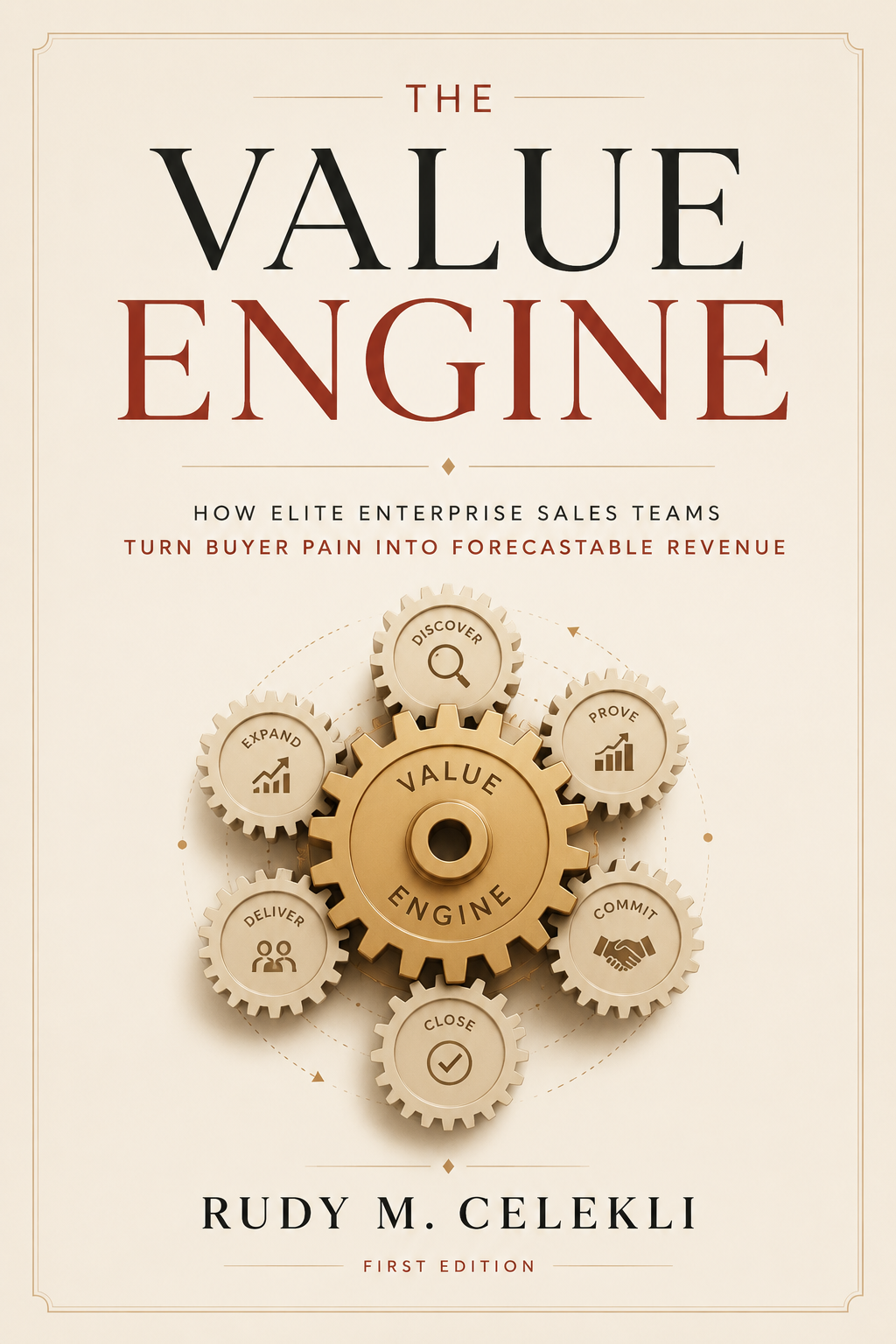
THE
VALUE ENGINE
How Elite Enterprise Sales Teams Turn
Buyer Pain into Forecastable Revenue
Rudy M. Celekli
First Edition
i
The Value Engine
Contents
Preface: Why I Wrote This · Author’s Note
Introduction: The Leader’s Mandate
Part One · Build the Case
1 The Philosophy: Selling the Delta
2 The Core Frameworks
3 The Eight-Stage Process
4 Discovery Mastery
Part Two · Prove the Case
5 Proof of Value Excellence
6 The Business Case: Revenue, Cost, Risk
7 Champions, Economic Buyers & Multithreading
8 Objection Handling
9 Mutual Action Plans & Close Plans
Part Three · Run the System
10 Negotiation & Procurement
11 Forecasting, Pipeline Discipline & the Operating Cadence
12 Post-Sale: Handoff, Adoption, Renewal & Expansion
13 The Deal Velocity System
14 The Artifact Library
15 Glossary & The Gold Standard on One Page
Epilogue · Afterword: The Method and the Machines · The Toolkit: Ten Field Templates · Appendix
ii
The Value Engine
Preface — Why I Wrote This
I have watched seven-figure deals die — not because the product failed, but because no one on the account team could explain the customer’s cost of delay in one sentence. The demo was flawless. The champion was enthusiastic. The proposal was beautiful. And in the meeting that mattered, when a CFO asked why this had to happen now instead of next fiscal year, the room went quiet. Quiet is how deals die. They almost never die loudly.
I came to sales from the technical side of the table. For years I was the solutions engineer — the one brought in to make the proof actually work, to survive the architecture review, to stand at the whiteboard while the buyer’s skeptics tried to break the story. That seat teaches you something no sales training does: buyers don’t believe claims, they believe evidence, and the deal is won or lost in the quality of the evidence long before anyone talks price.
iii
The Value Engine
Then came the stress test. In the economic hardship of the COVID years, DataRobot — like much of the industry — went through waves of workforce reductions, and Latin America took the hit hardest: the BDRs, the ADRs, the sellers — effectively the region’s entire go-to-market — were gone. What remained was me, the pre-sales technical lead, and a book of live contracts that still had to be supported. So I rebuilt the region from the ground up, alone at first, while still carrying the technical side and protecting every existing customer: system automations to do the work a team no longer could, a go-to-market strategy sized for one person and maximum leverage, pricing built for the region’s actual economics, and a reseller and partner network that multiplied me across countries I could not physically be in.
As RVP of Latin America I ended up being everything at once — the seller, the partner manager, the forecaster, and the leader responsible for the number — and I ran all of it on the system in this book. Following that method — and it is a method, closer to science than to art — internal reporting put LATAM ARR at roughly six times its starting level two years later. I will not claim the method was the only variable. But every deal ran through the same inspectable machine, the machine caught the weak ones early enough to fix them, and the partners ran the same playbook I did. I have run the stress test, involuntarily, with the region as the lab.
iv
The Value Engine
The pattern I have seen since, again and again, is the same. Sales organizations do not lose because their sellers lack talent or effort. They lose because the things their best sellers do instinctively — quantify the pain, test the champion, get the Economic Buyer conditionally committed before the proof begins — live in nobody’s system. They live in a few people’s heads, and when those people are stretched, promoted, or gone, the organization forgets how to win.
This book is that method, written down for the people who now sit where I sat. It does not claim to reinvent selling, and you should distrust any book that does. It codifies and operationalizes proven enterprise-selling disciplines — rigorous qualification, value engineering, insight-led teaching, proof governance — into one inspectable system: gates a deal must pass, evidence a deal file must contain, scores a leader can read at a glance, and questions to ask out loud in every deal review. The originality is in the assembly, and in the instruments built to hold it together.
v
The Value Engine
You will spend most of this book inside one deal — a fictional composite bank called Meridian, drawn in enough regulatory and operational detail that veterans of financial services should recognize every scene. I have deliberately left the team’s mistakes in: the demo that fired too early and cost eleven days, the ingestion error the vendor had to own out loud, the rival meeting they learned about a week late, the panicked concession a leader had to claw back. Real deals are not clean. What separates elite teams is not that they avoid these moments — it is that their system catches the moments early and gives them a way back.
Read it with your pipeline open. Argue with it. Replace my numbers with yours. And the next time someone tells you a deal feels strong, ask them what the customer’s cost of delay is — in one sentence, with a number in it. This book exists so that everyone on your team always has that sentence.
— Rudy M. Celekli
vi
The Value Engine
Author’s Note — The Case That Runs Through This Book
Every framework in this book is illustrated with a single running case: the pursuit, proof, close, and expansion of a transformational deal at Meridian National Bank — a top-ten U.S. bank by assets, with roughly 62 million retail customers, a Financial Crimes operation of several hundred analysts, and a regulator watching the clock. The vendor in the story, Northstar, sells an AI-powered decisioning and workflow platform. The deal is followed from first research to second-year expansion, with real numbers carried consistently through every chapter — the same discipline this book demands of your sellers.
Meridian, Northstar, and every named individual are fictional composites, assembled from the recurring patterns of real enterprise sales cycles in regulated industries. No case in this book describes an actual institution, deal, or person. Scenes labeled ‘In the Field’ are episodes of that composite case — teaching fiction, not reportage — and every Northstar statistic in these pages belongs to the same composite: illustrative, not measured. The texture, however, is drawn to be indistinguishable from the real thing. That is the point: you should recognize every scene.
Shorter vignettes from other industries — an energy supermajor, a global consumer-goods company, a federal logistics agency — appear where a second angle sharpens the lesson.
vii
The Value Engine
Introduction — The Leader’s Mandate
Selling is a transfer of confidence, backed by evidence. Leadership is the system that makes that transfer repeatable — across every seller, every quarter, every deal.
Most sales organizations do not have a selling problem; they have a variance problem. The top decile runs beautiful deals on instinct. Everyone else improvises. The gap between them is not talent — it is the absence of an operating system that makes the top decile’s instincts inspectable, teachable, and mandatory. This book is that operating system, written down. It does not pretend to be invented from scratch: it codifies and operationalizes proven enterprise-selling disciplines into one inspectable system, and its contribution is the assembly — the gates, the evidence standards, the scores, and the questions that make the whole thing run on purpose.
Read it in two passes. First, read the Meridian case straight through — the ‘In the Field’ sections tell one continuous story, from a cold Value Pyramid built off a 10-K to an $8.9 million three-year agreement and the expansion that followed. Second, read the frameworks and the Leader’s Lens sections with your own pipeline open in another window.
viii
The Value Engine
The one-line philosophy
Buyers do not allocate budget for software; they allocate budget to fix pain that is costing them revenue, cost, or risk.
The Cast of the Running Case
Meridian National Bank — The buyer — ~$1.9T assets; Financial Crimes drowning in alert volume, regulator's deadline approaching.
Northstar — The seller — AI decisioning & workflow platform, ~$140M ARR. A company-defining logo.
Dana Whitfield — SVP, Financial Crimes Operations — the champion. Owns the pain, 340 analysts, and the regulator relationship.
Marcus Hale — COO, Consumer & Community Banking — the Economic Buyer. Controls a $1.2B operations budget.
Priya Raman — Head of Model Risk Management — the blocker-turned-gatekeeper.
Alex Osei — Enterprise AE, Northstar — the seller whose deal we follow.
Jordan Kim — Solutions Engineer, Northstar — runs the technical motion and the POV.
Sam Torres — RVP of Sales, Northstar — the leader, whose inspection decisions appear in every Leader's Lens.
ix
The Value Engine
Part One · Build the Case
1
The Philosophy:
Selling the Delta
Value-based selling means anchoring every conversation on the customer’s business problems and outcomes — never on your product’s features. The product is only ever the mechanism; the value is the destination.
1
The Value Engine
The distinction sounds obvious and is violated daily. Feature selling leads with capabilities and demos, wins on checkbox comparisons and price, and creates interest. Value-based selling leads with the customer’s pains and desired outcomes, wins on a quantified business case and differentiated fit, and creates urgency. Interest gets you meetings. Urgency gets you signatures.
A leader’s first inspection question on any deal is simply: which kind of selling is happening here?
Every bad deal I have ever inspected was a feature-selling deal wearing a value costume. The costume comes off in one question: whose number is on the first slide — ours, or theirs?
2
The Value Engine
Two kinds of selling
| Feature Selling (variance) | Value-Based (the standard) |
|---|---|
| Leads with product capabilities and demos | Leads with the customer's pains, priorities, and desired outcomes |
| Talks about what the product does | Talks about what the customer's business becomes |
| Wins on checkbox comparisons and price | Wins on a quantified business case and differentiated fit |
| Creates interest | Creates urgency |
| Buyer evaluates you | Buyer builds the case with you |
3
The Value Engine
1.1 The Value-Based Conversation Model
Every deal narrative your team constructs should follow one eight-element structure — the DNA of this entire book and the backbone of every Economic Buyer conversation your sellers will ever run:
- 1.Before Scenario — the customer's current state, in their language, with the specific friction they live with today.
- 2.Negative Consequences — the measurable damage of staying there: lost revenue, cost, risk, missed roadmap, reputational exposure.
- 3.After Scenario — the concrete future state your solution creates.
- 4.Positive Business Outcomes — the quantified benefits of the After: faster time to value, higher ROI, reduced cost and risk.
4
The Value Engine
- 5.Required Capabilities — what any solution must have to move the customer from Before to After. This is where decision criteria get shaped.
- 6.Metrics — how success will be measured and proven, before and after.
- 7.How We Do It / Better — how your solution delivers each required capability, and why it does so better than the alternatives.
- 8.Proof Points — customer stories, benchmarks, and references that make the claim credible.
Running vertically through all eight: discovery questions — the questions that uncover which value drivers actually matter to this customer.
The delta (Δ) between Before and After is the value at stake. The entire job is to make that delta vivid, quantified, and attributable to you.
5
The Value Engine
1.2 Value Drivers: Where Conversations Begin
Value drivers are the problems a prospect is proactively trying to solve — top-of-mind business topics that exist whether or not your company does. Good value drivers share five properties: they are revenue, cost, or risk related; they exist independently of your product; they could cause a buyer to reallocate discretionary funds (the real test of urgency); they are mutually exclusive and collectively exhaustive as a set; and each maps to specific buyer personas who own that problem.
Most companies can express their value through three universal driver archetypes: getting high-value initiatives live (time to value), driving repeatability and scale across teams (avoiding one-off heroics), and maintaining quality in production as requirements, data, and markets change (protecting realized value). Adapt the language to your category; the architecture holds.
6
The Value Engine
1.3 Differentiators and Trap-Setting
Differentiators influence a technical buyer’s decision criteria through Required Capabilities. Every differentiator your team claims should be documented with four elements: a description, its customer value in revenue, cost, and risk, its defensibility from the customer’s point of view, and its trap-setting questions.
There are three types: unique (capabilities only you provide), comparative (superior attributes versus other vendors), and holistic (attributes that make a customer feel safe doing business with you — delivery track record, expert services, financial durability).
7
The Value Engine
A trap is a topic you raise deliberately because honest exploration of it leads the buyer to your differentiation — and away from competitors who cannot follow. Never lie, never disparage; simply make the buyer confront requirements only you satisfy. And keep the inherited word — trap — precisely because it is honest about intent. The discipline is that the trap must be true. A criterion that only helps you while the buyer isn’t looking is not a trap; it is a con.
Every trap has three moves: set the topic neutrally as a common client challenge; open the trap by probing the current process, its costs, and its failure modes; close the trap by inviting the buyer to describe the impact of the differentiated capability. The buyer articulates your value in their own words — the most powerful form of persuasion that exists.
Why traps matter
Set decisive decision criteria early. If your differentiator becomes a line item in the customer’s formal evaluation criteria before competitors even show up, you have won the deal before the bake-off begins.
8
The Value Engine
In the Field: The First Conversation at Meridian
Meridian National Bank · Month 1
The setup. Meridian’s Financial Crimes Operations group runs 340 in-house analysts — plus the contract-review bench that absorbs the overflow — adjudicating roughly 4.1 million AML and fraud alerts a year — about 22 minutes per alert, with a false-positive rate north of 90%. Six months earlier, the OCC issued a Matter Requiring Attention citing alert-backlog aging, with a remediation deadline of March 31. Dana Whitfield, the SVP who owns the function, has been asked by her COO for a plan twice. Northstar’s AE, Alex Osei, gets thirty minutes with her through a former colleague.
The feature-selling version of this call — the one Alex’s competitor ran two weeks earlier — opened with a platform demo and a slide titled ‘Our AI Advantage.’ Dana gave them the second fifteen minutes to her deputy.
9
The Value Engine
Alex’s version opened on the value driver Dana already owned: “Most financial-crimes leaders we work with are caught between two clocks right now — alert volume compounding at fifteen to twenty percent a year, and a regulator’s calendar that doesn’t care. Where does that sit for you?”
Twenty-two of the thirty minutes were Dana talking. Alex asked four questions, wrote down three verbatim quotes, and never opened a slide. The trap he set — neutrally — was Meridian’s model-governance process: “When teams here have tried to automate adjudication before, what happened when the model hit Model Risk Management review?” Dana’s answer (“It died there. Fourteen months, then dead”) handed Northstar its differentiation battlefield: explainability and audit-ready decisioning, the one requirement the incumbent point solutions could not survive.
10
The Value Engine
What made the delta vivid was one sentence Alex constructed from Dana’s own numbers before the call ended: “So the current process consumes roughly one and a half million analyst hours a year to find the four percent of alerts that end in a real investigation — and the backlog it creates is now a regulatory finding.”
Dana’s reply went straight into the deal file: “That’s the sentence I’ve been trying to get my leadership to hear for two years.”
11
The Value Engine
The Leader’s Lens — What to Inspect
The failure smell: deal reviews where the seller can recite the product story but not the customer’s Before Scenario in the customer’s vocabulary. If the first three minutes of a deal review are about your platform, stop the review.
Questions to ask out loud: “Say the Before Scenario in the customer’s words — what quote do you have?” · “Which value driver did we anchor to, and who owns it?” · “What trap have we set, and what decision criterion did it produce in writing?” · “If I called the champion right now, could they tell me the delta in one sentence?”
The coaching move: require one verbatim stakeholder quote in the CRM before any deal advances past discovery. Quotes are currency in the Economic Buyer conversation; a deal file without them is a deal built on paraphrase.
12
End of Chapter One
Fourteen chapters to go.
The frameworks, the eight-stage process, the Meridian deal from cold 10-K to an $8.9M signature — and the leader’s system that makes it all inspectable.
Get the BookDrag a corner to flip
Your best sellers run a system. Nobody wrote it down — until now.
Most sales organizations do not have a selling problem; they have a variance problem. The top decile runs beautiful deals on instinct. Everyone else improvises. The gap is not talent — it is the absence of an operating system that makes the top decile’s instincts inspectable, teachable, and mandatory.
The Value Engine is that operating system, written down: gates a deal must pass, evidence a deal file must contain, scores a leader can read at a glance, and questions to ask out loud in every deal review — all demonstrated end to end on one running case, a transformational deal at a top-ten U.S. bank (a fictional composite, drawn to be indistinguishable from the real thing), from a cold 10-K to an $8.9M three-year agreement and the expansion that followed.
“Build the case. Prove it. Deliver measurable value. Expand inside the account.”
Three parts. Fifteen chapters. One inspectable machine.
01
Part One
Build the Case
Philosophy, frameworks, process, and discovery.
- 1The Philosophy: Selling the Delta
- 2The Core Frameworks
- 3The Eight-Stage Process
- 4Discovery Mastery
02
Part Two
Prove the Case
Proof, business cases, champions, objections, and close plans.
- 5Proof of Value Excellence
- 6The Business Case: Revenue, Cost, Risk
- 7Champions, Economic Buyers & Multithreading
- 8Objection Handling
- 9Mutual Action Plans & Close Plans
03
Part Three
Run the System
Negotiation, forecasting, post-sale, and the leader's cadence.
- 10Negotiation & Procurement
- 11Forecasting, Pipeline Discipline & the Operating Cadence
- 12Post-Sale: Handoff, Adoption, Renewal & Expansion
- 13The Deal Velocity System
- 14The Artifact Library
- 15Glossary & The Gold Standard on One Page
Plus: the Epilogue (The Leader’s Operating Rhythm), the Afterword (The Method and the Machines — how the whole system was stress-tested against frontier AI models on the Value Engine Benchmark), the Toolkit of ten field templates, and a full appendix of sources, methods, and attributions.
Frameworks that hold the system together
The originality is in the assembly — proven enterprise-selling disciplines codified into one system, with the instruments built to hold it together.
Narrative spine
The 3 Whys
Why Buy Anything? Why Buy Us? Why Now? — answered in the customer's own words, with named owners and a number attached. No 3 Whys, no deal; just a conversation.
Discovery loop
A.X.I.O.M.
Anchor, eXplore, Impact, Own, Mobilize — a five-beat discovery structure. Where the loop breaks tells you exactly what the deal is missing.
Qualification OS
MEDDPICC Evidence Scoring
Every letter scored 0–3 on documented evidence, not optimism. The lowest letter is the deal's real score — and this week's workstream.
DVI · 0–100
The Deal Velocity Index
Five weighted evidence components roll up to one inspectable deal-health score. No deal enters Commit below 75. The instrument disagrees with optimism so your forecast doesn't have to.
The one-pager
The Value Delta
Before, After, and the annualized value at stake — headline and conservative floor side by side, on a single page. The best artifacts sell in rooms you will never enter.
MAP
Mutual Action Plans
Customer-confirmed dates working backward from their go-live, not your quarter end. A MAP the customer never confirmed is a wish with columns.
Rudy M. Celekli
Solutions Engineer → RVP, Latin America
~6×
LATAM ARR growth in two years (internal reporting)
1
Person the region was rebuilt with
100%
Of deals run through the same inspectable machine
I have watched seven-figure deals die — not because the product failed, but because no one on the account team could explain the customer’s cost of delay in one sentence. The demo was flawless. The champion was enthusiastic. And when a CFO asked why this had to happen now instead of next fiscal year, the room went quiet. You already know how that story ends.
I came to sales from the technical side of the table. For years I was the solutions engineer — the one brought in to make the proof actually work, to stand at the whiteboard while the buyer’s skeptics tried to break the story. That seat teaches you something no sales training does: buyers don’t believe claims, they believe evidence.
Then came the stress test. In the COVID downturn, DataRobot’s Latin America go-to-market — BDRs, ADRs, sellers — was effectively gone. I rebuilt the region alone: automations to do the work a team no longer could, a go-to-market sized for one person and maximum leverage, and a reseller network that multiplied me across countries I could not physically be in. As RVP I ran all of it on the exact system in this book — and internal reporting put LATAM ARR at roughly six times its starting level two years later. I won’t claim the method was the only variable. But every deal ran through the same inspectable machine, and the machine caught the weak ones early enough to fix them.
This book is that method, written down for the people who now sit where I sat.
Get the book
Read it with your pipeline open.
Argue with it. Replace the numbers with yours. And the next time someone tells you a deal feels strong, ask them for the customer’s cost of delay — in one sentence, with a number in it.
Included with every copy — free
Every buyer gets the Excel Live Workbook — with live DVI scoring, integrity flags, and a pipeline dashboard — plus the Field Toolkit of all ten templates, ready to rebuild in your CRM, your slides, and your deal reviews.
Free download
Get the Field Toolkit — ten templates + the Live Workbook, free.
Every artifact the book demands, in fill-in form: the Value Pyramid, the 3 Whys Builder, the A.X.I.O.M. call plan, the MEDDPICC scorecard, the DVI scorecard, and more — plus the auto-calculating Excel Live Workbook. The fields are the minimum evidence standard — and an empty field is a finding, not a formality.
Prefer the details first? See everything in the pack →
Send me the Field Toolkit
Ten templates plus the Live Workbook, delivered to your inbox. Templates import cleanly into Notion and Google Docs; the Workbook opens in Excel and Google Sheets.
The companion app
Don’t just read the system. Run it.
The Value Engine app is an AI buyer that calls you— scores your discovery in real time, and debriefs every call against the book’s frameworks.
Start a practice call▸ POST-CALL DEBRIEF
A.X.I.O.M. loop ....... broke at Impact
3 Whys captured ....... 2 of 3
Verbatim quotes ....... 1 logged
MEDDPICC lowest ....... E (score 1)
DVI 58 / 100— develop, don’t forecast.